
SmartWorks Network

  • Home
  • RSS Blog
  • YouTube channels
  • Podcasts
  • Jobs
  • Tools
  • About us
  • Contact

Attackers target Apache Hadoop and Flink to deliver cryptominers

by Valentin / Monday, 15 January 2024 / Published in RSS blog posts

Cyber Security BlogsResearchers devised a new attack that exploits misconfigurations in Apache Hadoop and Flink to deploy cryptocurrency miners.

Cybersecurity researchers from cyber security firm Aqua have uncovered a new attack targeting Apache Hadoop and Flink applications. The attacks exploit misconfigurations in Apache Hadoop and Flink to deploy cryptocurrency cryptocurrency miners.

The researchers reported that the attack is particularly intriguing because threat actors use packers and rootkits to conceal the malware.

Apache Hadoop is an open-source software framework designed for the distributed storage and processing of large sets of data using a cluster of commodity hardware. It is part of the Apache Software Foundation’s efforts and is widely used for handling big data and performing parallel processing tasks.

Apache Flink is an open-source, unified stream-processing and batch-processing framework developed by the Apache Software Foundation.

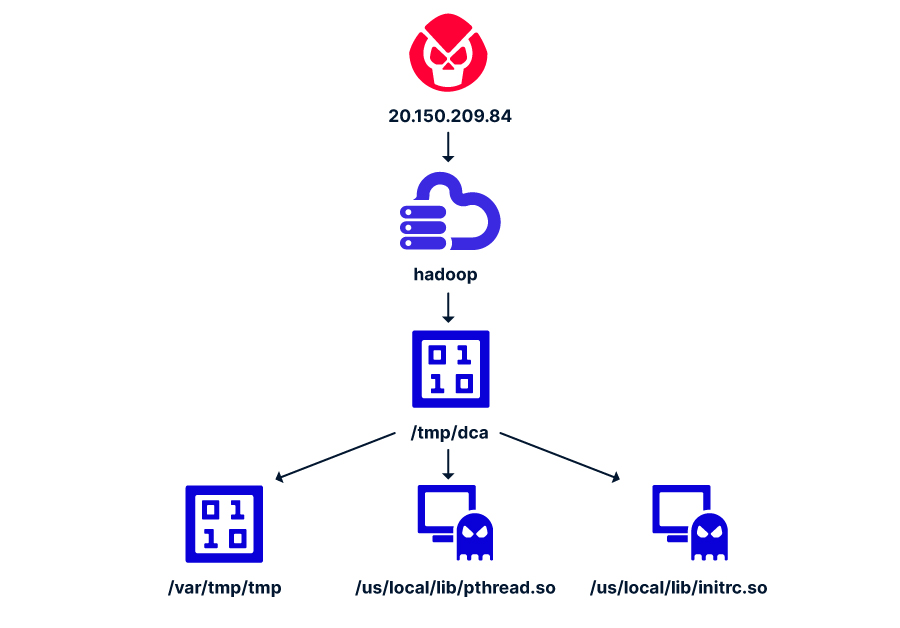
The attack is very simple, attackers exploit a misconfiguration of the ResourceManager of the YARN in Hadoop to drop and executed the binary dca which downloads two other binaries (rootkits) and writes to disk a Monero cryptominer. 

The attacker sends an unauthenticated request to deploy a new application, then he attempts

to to run a remote code by sending a POST request to the YARN, requesting to launch the new application with the attacker’s command. 

The misconfiguration allows an unauthenticated, remote threat actor to execute arbitrary code through a specially crafted HTTP request. An attacker can execute arbitrary code depending on the privileges of the user on the node where the code is executed. 

The attack against the Apache Flink is quite similar and exploits a misconfiguration that allows a remote, unauthenticated attacker to achieve code execution.

“The attack employs sophisticated evasion techniques, including the use of packed ELF binaries and rootkits that are undetected by regular security solutions. The malware deletes contents of specific directories and modifies system configurations to evade detection.” states the report. “Persistence is achieved by manipulating cron jobs to download and execute a script that deploys the ‘dca’ binary. The infrastructure used by the attackers includes specific IP addresses and domains.”

The report also includes Indications of Compromise (IoCs) for this attack.

Follow me on Twitter: @securityaffairs and Facebook and Mastodon

Pierluigi Paganini

(SecurityAffairs – hacking, Apache Hadoop)

​Read More

  • Tweet

About Valentin

What you can read next

Kanti: A NIM-Based Ransomware Unleashed in the Wild
Tines’ AI features enhance workflow automation for security and IT teams
Threat Actor Targeting Developers via Trojanized MS Visual Studio

Leave a Reply Cancel reply

Your email address will not be published. Required fields are marked *

Recent Posts

  • Sniffnet: Free, open-source network monitoring
  • 90% of threats are social engineering
  • 78% of SMBs fear cyberattacks could shut down their business
  • Chinese attackers leverage previously unseen malware for espionage
  • Long-running Chinese cyberespionage operation targeted Southeast Asian government

Recent Comments

No comments to show.

Recent Posts

  • Sniffnet: Free, open-source network monitoring

    Cyber Security Blogs Sniffnet is a free, open-s...
  • 90% of threats are social engineering

    Cyber Security Blogs In this Help Net Security ...
  • 78% of SMBs fear cyberattacks could shut down their business

    Cyber Security Blogs 94% of SMBs have experienc...
  • Chinese attackers leverage previously unseen malware for espionage

    Cyber Security Blogs Sophos released its report...
  • Long-running Chinese cyberespionage operation targeted Southeast Asian government

    Cyber Security Blogs Researchers have uncovered...

Archives

  • June 2024
  • May 2024
  • March 2024
  • January 2024

Categories

  • RSS blog posts

Meta

  • Log in
  • Entries feed
  • Comments feed
  • WordPress.org

Recent Comments

    Featured Posts

    • Sniffnet: Free, open-source network monitoring

      0 comments
    • 90% of threats are social engineering

      0 comments
    • 78% of SMBs fear cyberattacks could shut down their business

      0 comments
    • Chinese attackers leverage previously unseen malware for espionage

      0 comments
    • Long-running Chinese cyberespionage operation targeted Southeast Asian government

      0 comments

    SEARCH

    RECENT POSTS

    • Sniffnet: Free, open-source network monitoring

    • 90% of threats are social engineering

    • 78% of SMBs fear cyberattacks could shut down their business

    TAG CLOUD

    ©2024 All rights Reserved @Smart Works Network

    TOP